Building Together: The Springdale Data Center Project
A New Chapter For Our Community
"*" indicates required fields
Dear Neighbors,
Springdale Borough stands at an exciting crossroads. Where the Cheswick Generation Station once powered homes across Pennsylvania, a new opportunity has emerged—one that honors our industrial heritage while building toward a vibrant economic future. Allegheny DC is proposing to transform this retired coal plant site into a state-of-the-art data center, and we want you to understand what this means for our community.
That’s why we’ve created this website and why we are setting out to have a conversation with the Springdale Borough and the communities that surround it. We know you have questions, and we hope that this site and this conversation can serve as a place to get answers backed by facts in a transparent way.
The Cheswick Generation Station served our region well for decades, but its closure left behind an idle industrial site. Rather than letting this industrial property sit vacant, this project represents a thoughtful approach to adaptive reuse—taking what's already there and giving it new life. This isn't about building something from scratch in an untouched area; it's about revitalizing a brownfield site that's already industrial in nature.
This approach makes sense for Springdale. We preserve our community character while breathing new economic life into an industrial property that's already part of our landscape.
Springdale has a proud history as a community built by hard work and industry. The Cheswick Generation Station was part of that story for decades. Now we can write the next chapter -- one that honors our past while building toward a prosperous future.
This project represents more than just a data center. It's about economic transition, job creation, tax revenue that funds the services we depend on, and positioning Springdale for long-term success in a changing economy.
The choice before our community is clear: embrace thoughtful, well-regulated development of an existing industrial site, or watch that industrial property sit idle while other communities benefit from this type of investment.
Allegheny DC is committed to regulatory compliance, transparent community engagement, and developing a facility that contributes positively to Springdale Borough and the Commonwealth of Pennsylvania.
We can build a stronger Springdale. Together.
Where we once powered homes, we'll now power careers, schools, and community services.
"We’re in the middle of something much bigger than the Industrial Revolution It’s like a massive change and change and disruption… I think we have to show people is that the benefit first of all, it’s happening whether we like it or not, and that the benefits for Pennsylvania far exceed those challenges."
10/30/25
"It (AI) will likely lead to a new era, just as the agricultural revolution and industrial revolution did in this country over the last century or so. It is, of course, evolving far more rapidly than any other technology in the past two decades, and it holds great promise, as long as we are clear-eyed in our purpose."
3/21/25
You hear a lot about challenges that come with data centers, but there are some benefits that are simply undeniable.
Jobs and Opportunity
Economic development isn't just about numbers on a page—it's about opportunities for our neighbors, family members, and friends. This project will create meaningful employment at multiple stages:
During Construction:
Long-Term Employment:
Current Reality: The former Cheswick site currently generates approximately $66,000 in total annual real estate taxes across the borough, school district, and county.
Future Potential: A completed data center is conservatively estimated to generate approximately $2.56 million in annual real estate taxes—an increase of nearly $2.5 million per year.
What This Means for You:
For Springdale Borough:
For Our School District:
You may have read about data center developments in other communities—some with challenges. It's fair to wonder what makes the Springdale project different. Here's the truth: location, approach, and partnership make all the difference.
Built on the Right Foundation
This isn't greenfield development. The Springdale data center will rise on the site of the former Cheswick Generation Station—an industrial property that's already served heavy industrial use for decades. We're not converting farmland, residential areas, or open space. We're transforming an existing brownfield site that's already part of our industrial landscape.
This matters because the infrastructure is already there. The site was built to handle major industrial operations. The electrical transmission infrastructure exists. The land use pattern is established. We're utilizing the existing infrastructure in a way that positions the site and the community for our new economy that Senator McCormick and Governor Shapiro has highlighted – all while benefiting the community.
Most Importantly, We Are Doing It Different
Honoring our industrial heritage while building toward a tech future – all with the guiderails your community wants.
What’s before us now is the chance to have the benefits in our community rather than another community. We need leaders who put forth energy policies that prioritize generation, so PA can be at the forefront of the energy and data revolution.
The process we have initiated includes many significant checks and balances, designed to protect the community’s rights and interests during the development process, including:
We will do this in a safe and additive way. And most importantly, we will do it together.
Q: How much water will the data center use?
The Springdale Data Center is designed to use approximately the same amount of water as one Olympic-sized swimming pool. This represents a drastic reduction compared to many early-generation data centers, reflecting our commitment to responsible resource management.
Q: Where will the water come from?
After an initial draw from a municipal water source the data center will utilize a recycled water system for cooling. This closed-loop system reuses water rather than consuming fresh water continuously.
Q: Will this impact the local water system or increase residents' water bills?
Initial conversations with officials at the water system that serves the borough indicate that this use will not be a tax on their system. Allegheny County requires confirmation of adequate water supply as part of the land development approval process. Our water usage was designed specifically in response to early community concerns, and we've engineered a solution that minimizes impact on the municipal water supply.
Q: How does the recycled water system work?
The recycled water system is a closed-loop cooling system that continuously reuses the same water for temperature regulation within the facility. This technology significantly reduces ongoing water consumption compared to traditional once-through cooling systems.
Q: How much power will the data center consume?
The data center is designed to use up to 180 megawatts of power. For context, this is equivalent enough to power approximately 150,000 homes.
Q: Will this data center cause my electricity bills to increase?
Due to Pennsylvania’s participation in a multi-state grid system, this project will not directly contribute to a rise in local electricity rates. Increases in energy demand, and decreases in available energy supply, across the multi-state grid have and will result in an increase in the cost of electricity across the grid. However, siting a high-demand energy consumer in one community does not directly lead to an increase in electricity bills for that community. On the other hand, the economic benefits of a data center, such as tax increases, will be felt most by the community in which it is physically located.
Q: Why won't this affect local electricity rates?
PJM Interconnection, the regional transmission organization that coordinates the flow of electricity across 13 states, including Pennsylvania, is responsible for ensuring adequate electric supply is available to meet customer demand. It operates as a whole-sale electricity market, and spikes in demand, or decreases in supply, anywhere under PJM’s jurisdiction can impact the overall cost of electricity through increases in PJM capacity charges. These increases are then passed down to utility companies. The increased overall cost causes utility companies to raise their service fees, but they can only do so if the rate increase is approved by the Pennsylvania Public Utility Commission.
In other words, energy demand and pricing are determined at the grid level, not locally. Data center development anywhere within this grid will contribute to regional demand. Since this demand exists regardless of location, siting a new data center elsewhere will not protect Springdale from electricity rate increases. The choice is whether Springdale benefits from hosting such a facility or whether those benefits go to another community.
Q: Where will the power come from?
The exact power source has not been finalized, but western Pennsylvania offers a variety of energy options including natural gas, nuclear, and renewable sources. The region's diverse energy infrastructure is one of the reasons this location is attractive for data center development.
Q: Is the Governor addressing energy costs?
Energy usage and costs are on the rise statewide. The Public Utility Commission and Governor Shapiro are actively looking at ways to address this issue and bring costs down for all Pennsylvanians.
Q: How loud will the data center be?
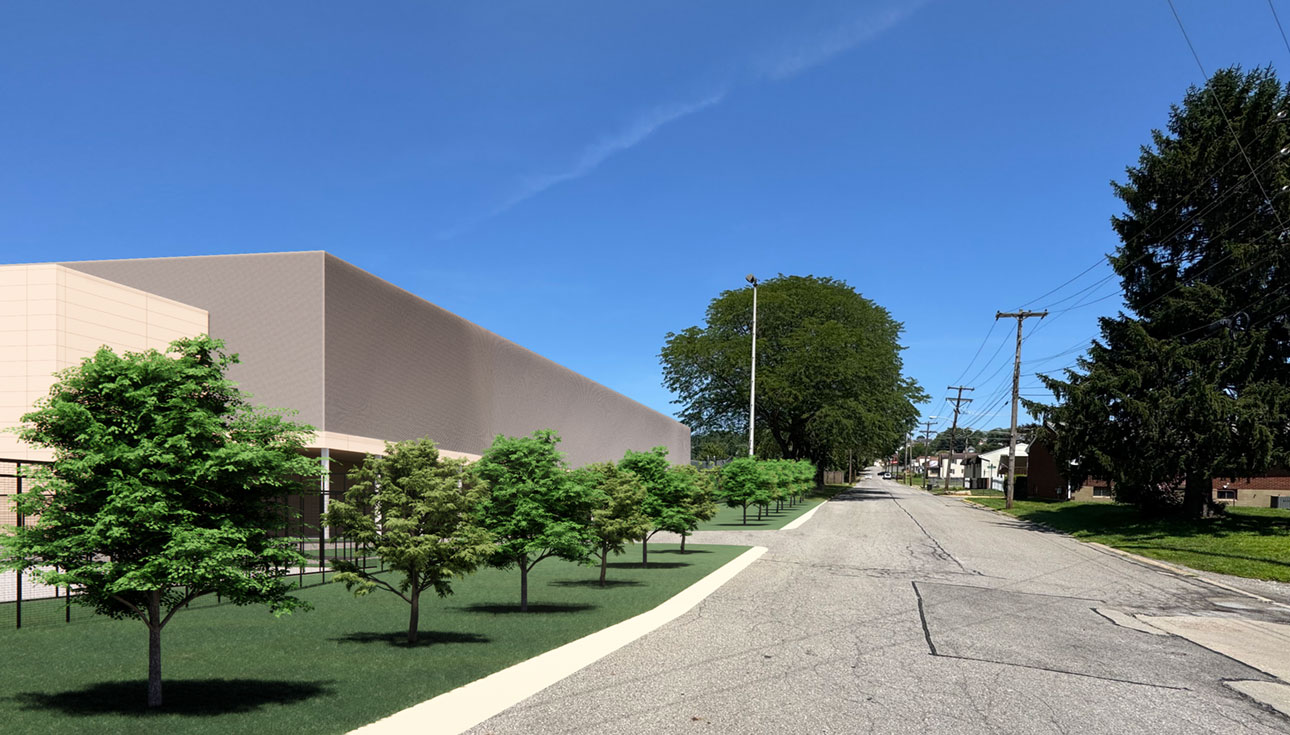
The development team has committed to not only meeting but exceeding the local sound limits for the industrial district. According to preliminary acoustic modeling, sound levels will be like local ambient levels during normal operations. All current modeling and analyses indicate that the proposed design will be able to meet applicable sound limits.
Q: What steps will be taken to minimize sound?
Our sound experts have outlined comprehensive steps to minimize noise that residents hear. These currently include physical barriers, equipment selection, equipment siting, and operational restrictions such as limits on the hours of operation. We are projected to perform better than required by Borough regulations according to the acoustic models that have been presented to the community.
Q: Will there be ongoing noise monitoring?
The developers consented to additional noise modeling during later stages of design, as well as to sound mitigation measures if necessary to ensure noise is properly managed.
Q: Has there been a noise study conducted?
Yes. Sound modeling has been performed and reviewed by a third-party acoustical consultant hired by the Borough as well as by a second acoustical engineer engaged by the developer. An ambient noise study has been conducted by the developer as well as a third-party acoustical consultant hired by the Borough. The team has committed to being as aggressive as possible in mitigating sound impacts for the community.
Q: What if sound levels exceed projections?
The developers have committed to implementing additional mitigation measures if needed. They have stated publicly that they will do whatever is necessary to ensure sound is properly mitigated for the community.
Q: How many jobs will the data center create?
The project is projected to create 500-1,000 short-term construction jobs and 80-100 permanent positions once operational. These are quality jobs for skilled workers including electricians, HVAC technicians, and mechanical specialists.
Q: What kind of skills are needed for these jobs?
These positions don't necessarily require advanced degrees. The data center needs people with strong mechanical skills who know how to build and maintain complex systems. Western Pennsylvania has a strong workforce with these exact capabilities, developed through our industrial heritage.
Q: How much property tax revenue will the data center generate?
A preliminary analysis indicates that this development would generate over $2.5 million in annual property tax revenue for the fiscally strained community of Springdale Borough and the surrounding area, including the Allegheny Valley School District and Allegheny County.
Q: What will this tax revenue fund?
How tax dollars are spent is up to the Borough and other taxing bodies, but as part of the Borough’s or School District’s general fund, these revenues could support:
Q: Why is this site a good location for a data center?
The former Cheswick Generation Station site is ideal because it's an existing industrial brownfield property with:
Q: What happens if the data center isn't built?
There are no other current proposals for this property, and it is likely that, at least for the time-being, the industrial site would remain idle. The choice facing the community is clear: embrace thoughtful development of an existing industrial property, or watch it sit vacant while other communities benefit from similar investments. The facility will be built somewhere in the region to meet demand - the question is whether Springdale captures the benefits.
Q: What happens next?
If Borough Council approves the pending Conditional Use Application, that is only step one in the permitting process. A “yes” vote from Council would mean that in concept, a data center like the one proposed is allowed to be located on that property, under the local zoning ordinance. The developer would then begin a more thorough design process in preparation for an application to Allegheny County for “Land Development” approval under the Allegheny County Subdivision and Land Development Ordinance, known as the “SALDO”. The SALDO has extensive mandatory design standards, and the developer will need to prove to the County Planning Department that it can meet all of those requirements. The County will require submission of a photometric plan, landscaping plan, and other details. The developer will also have to prove that it has met any binding conditions of approval placed on the project by the Borough. If the County approves the Land Development Plan, the developer will need to move forward with other permitting, such as air quality permitting and state-level environmental permitting. Ultimately, once all other agencies have signed off, the developer will have to come back to the Borough to request a building permit. The developer is committed to holding public meetings throughout this process to keep the public up to speed.
The Springdale Data Center represents unprecedented benefits for the community - from hundreds of jobs to millions in property tax revenue that can help fiscally strained communities. These investments represent contributions to pension funds for police officers and teachers, better roads and parks, and the foundation for a brighter future for Springdale.
Paid for by Allegheny Property Company, LLC